

 |
Photo courtesy of Yonhap News |
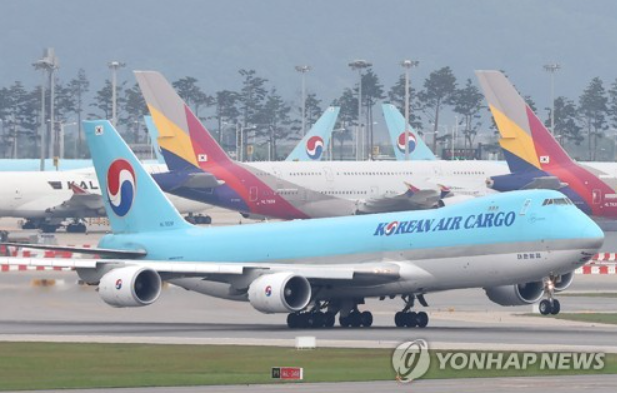
[Alpha Biz= Ellie Kim] South Korean exporters are set to face higher logistics costs as air cargo fuel surcharges rise again this month, extending last month’s sharp increase driven by surging jet fuel prices amid geopolitical tensions involving the U.S., Israel and Iran.
According to industry sources on May 8, major Korean carriers operating cargo aircraft—including Korean Air—will raise fuel surcharges applied from May 16 by approximately 3% compared to the previous month.
Korean Air has set its air cargo fuel surcharge at KRW 2,020–2,260 per kilogram for shipments beginning May 16, up about 3.1% from KRW 1,960–2,190 last month. The airline had already increased surcharges by an average of nearly 494% in April, reflecting a sustained rise in jet fuel prices.
The carrier said the Singapore jet fuel spot price (MOPS) averaged USD 4.772 per gallon last month, up 2.6% month-on-month.
Other carriers, including Asiana Airlines and Air Zeta, are implementing similar increases. Asiana Airlines will apply a surcharge of KRW 2,020–2,260 per kilogram from May 16, up about 3.1% from the prior month. Air Zeta, which acquired Asiana’s cargo business unit, will charge KRW 1,980–2,220 per kilogram, also reflecting a roughly 3.1% increase.
Despite already raising surcharges by 326% and 334% respectively in April, Asiana Airlines and Air Zeta have opted for another hike as jet fuel prices remain elevated. Compared to a year earlier, this month’s surcharges are more than 510% higher.
Before the outbreak of conflict between the U.S., Israel and Iran, surcharges had remained relatively low—around KRW 330–370 per kilogram as recently as February, with last year’s average ranging between KRW 390 and KRW 450.
Air cargo fuel surcharges are calculated based on both distance and weight, with routes categorized into short-, medium-, and long-haul segments. Long-haul routes—including Europe and North America—carry the highest burden, meaning exporters shipping goods to these regions face significantly higher costs.
For example, shipping one metric ton of goods to the U.S. or Europe via Korean Air would incur a fuel surcharge of approximately KRW 2.26 million starting May 16, up from just KRW 510,000 in March.
Semiconductors account for the largest share of Korea’s air cargo exports, meaning manufacturers such as Samsung Electronics and SK Hynix are expected to bear a substantial increase in freight costs.
Alphabiz Ellie Kim 인턴기자(press@alphabiz.co.kr)

















![[현장] 위기의 K무비, 결국 또 ‘쿠폰 살포’ 미봉책인가…혈세로 덮는 영화계 침체](/news/data/20260508/p1065601751569568_446_h2.jpg)