 |
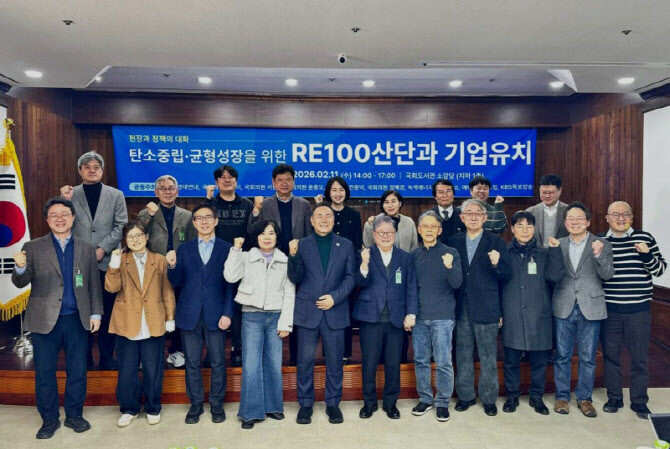
Prof. Jong Ho Hong of the Graduate School of Environmental Studies at Seoul National University (third from left in the front row) and Prof. Younghwan Jeon of the School of Electronic and Electrical Engineering at Hongik University (sixth from left in the front row), along with other participants, pose for a commemorative photo at the RE100 industrial complex forum held at the National Assembly Library in Seoul on Feb. 11.
(Photo courtesy of the Energy Transition Forum) |
[Alpha Biz= Kim Jisun] Stronger price signals needed to shift energy-intensive industries to power-surplus regions, forum participants say
Even if the proposed Yongin semiconductor cluster is not developed, the Greater Seoul area could face structural limits in electricity supply, experts warned, calling for the introduction of a robust regional differential electricity pricing system to rebalance power demand nationwide.
At a recent policy forum, participants argued that regardless of ongoing discussions about relocating the Yongin cluster, strong pricing incentives are needed to encourage industries concentrated in the capital region to move to non-capital regions where power generation capacity is more abundant.
With the exception of certain areas such as Incheon, the capital region lacks sufficient power plants and relies heavily on electricity transmitted from Chungcheong, Gangwon, and the Yeongnam and Honam regions. Meanwhile, peak power consumption in the capital region has already reached between 90 gigawatts (GW) and 100GW—accounting for roughly half of the nation’s maximum electricity demand—highlighting a significant supply-demand mismatch.
If the Yongin semiconductor cluster proceeds as currently planned, it is expected to require approximately 15GW of steady power demand after 2040, which could further exacerbate the structural imbalance in the capital region’s electricity supply.
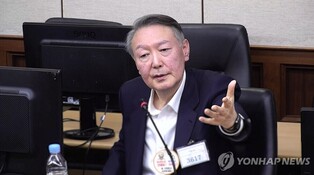
Professor Jeon, speaking at the forum, stressed that attempting to resolve the issue solely through expansion of transmission infrastructure would entail not only social conflicts and high costs, but also technical risks that could undermine grid stability.
“We must abandon the assumption that electricity can be supplied under identical conditions everywhere,” he said. “A transition toward a system that aligns power production with consumption regions is essential.”
Professor Jeon and other panelists agreed that policies introducing regional differential electricity pricing would provide companies with strong financial incentives to relocate to regions offering lower electricity rates.
They noted that Gwangju and South Jeolla Province have renewable energy potential of approximately 15GW, while Ulsan has plans to develop 6.2GW of large-scale offshore wind power. With ample sites suitable for establishing RE100 (100% renewable energy) industrial complexes across various regions, participants argued that sufficient “price signals” from authorities could effectively disperse national energy demand away from the capital region.
Alphabiz Reporter Kim Jisun(stockmk2020@alphabiz.co.kr)