 |
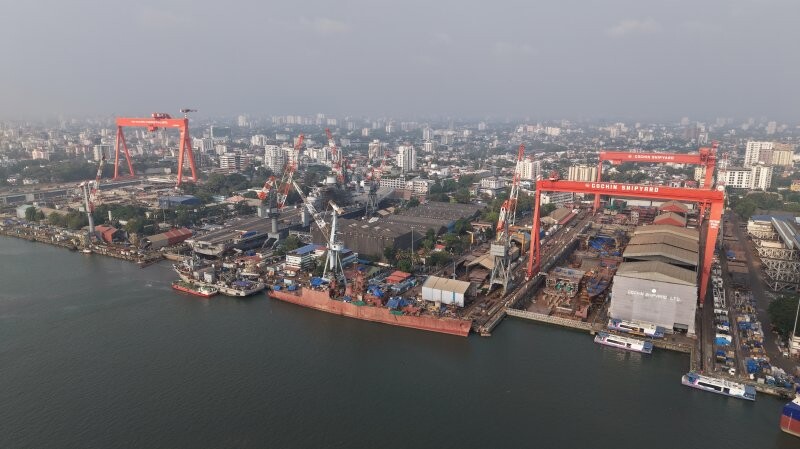
Cochin Shipyard, India. (Photo courtesy of HD Hyundai Heavy Industries) |
[Alpha Biz= Kim Jisun] South Korea’s HD Hyundai and India’s largest state-owned shipbuilder, Cochin Shipyard (CSL), are reportedly pursuing the establishment of a shipbuilding joint venture valued at approximately USD 500 million, according to Indian media reports.
Indian Prime Minister Narendra Modi has elevated shipbuilding to a national strategic industry, presenting the Maritime Amrit Kaal Vision 2047, which seeks to foster integrated development across ports, shipping, and shipbuilding. The plan aims to position India among the world’s top five shipbuilding and maritime powers by 2047. In this context, the Indian government has actively explored cooperation with South Korea’s shipbuilding industry.
On Monday, Indian media cited industry sources as saying that HD Korea Shipbuilding & Offshore Engineering, HD Hyundai’s intermediate holding company, and Cochin Shipyard are in the final stages of negotiations to form a joint venture on a 50:50 equity basis. The sources added that the parties are targeting the second half of 2026 to finalize the agreement. To this end, a Cochin Shipyard delegation is expected to visit South Korea later this month to conclude discussions.
The proposed joint venture is widely expected to construct a ship block manufacturing facility near Cochin Shipyard’s existing yard in the Kochi region of India. The project under review involves developing an approximately 80-acre site with an annual production capacity of about 120,000 tons. Once completed, the facility is expected to create around 2,000 direct jobs and generate significant spillover effects across related industries, including steel, ship equipment, and logistics.
According to local media, the block plant would operate by producing large hull modules that are subsequently assembled in a dry dock. The facility is expected to utilize Cochin Shipyard’s 310-meter-long dry dock, which was completed in January 2024, enabling the construction of up to six vessels per year in the 300-meter class.
Target vessels reportedly include Suezmax crude oil tankers, container ships, and Capesize bulk carriers. Very large crude carriers (VLCCs), however, are not expected to be included in the initial scope of the project due to current infrastructure constraints.
Alphabiz Reporter Kim Jisun(stockmk2020@alphabiz.co.kr)