

 |
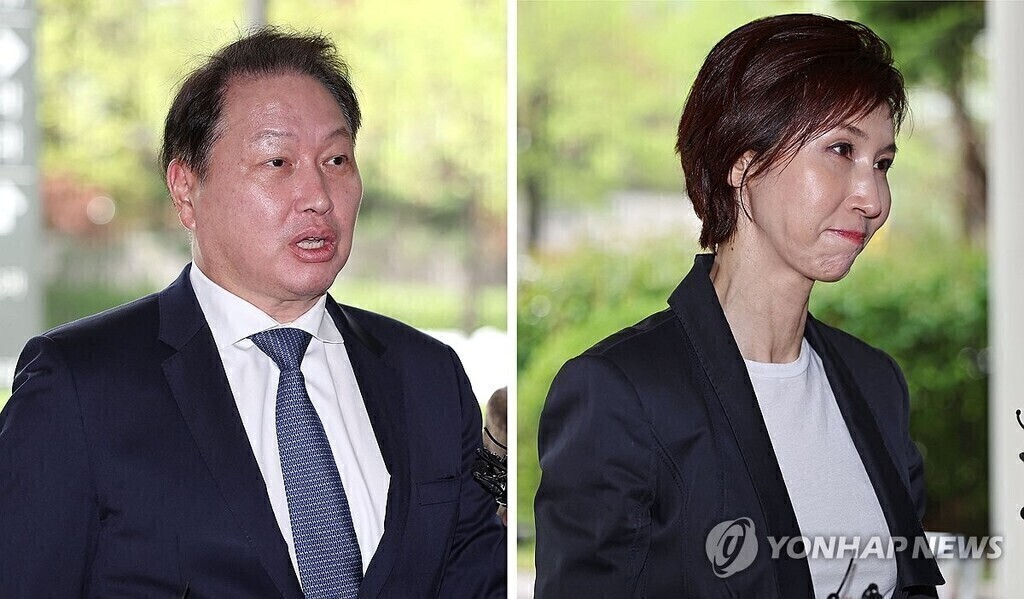
SK Group Chairman Chey Tae-won and Art Center Nabi Director Roh So-young pose for a photo. (Photo: Yonhap News) |
[Alpha Biz= Kim Jisun] Chey Tae-won, chairman of SK Group, and Roh So-young are set to face each other in court for the first time in more than two years as their divorce dispute over a 1.38 trillion won ($1 billion) asset division reaches a critical stage.
According to legal sources on June 14, the Seoul High Court’s Family Division will hold the second mediation hearing on June 15 at 2 p.m. in the remanded case concerning the division of marital assets.
This marks the first in-person court appearance by both parties since the final appellate hearing in April 2024, and their first since the Supreme Court ruling last year. At the initial mediation session held last month, only Roh attended, with the court reportedly proposing a rescheduled date to ensure Chey’s participation.
The key issue in the mediation is whether shares of SK Inc. held by Chey qualify as marital property. Roh argues the shares should be considered jointly accumulated assets, while Chey maintains they are inherited personal property and not subject to division.
Recent court communications reportedly suggested that the SK shares could be classified as marital property, making the scale and method of asset division a decisive factor in the case.
The case has seen significant shifts across court rulings. The first trial ordered Chey to pay 66.5 billion won to Roh.
In contrast, the appellate court recognized Roh’s contribution, citing that 30 billion won in slush funds from her father, former President Roh Tae-woo, had been used in the growth of SK Group.
Based on this, the appellate court ruled that Chey should pay 1.38 trillion won—equivalent to 35% of the couple’s estimated 4 trillion won in joint assets—marking the largest asset division in South Korean divorce history.
However, the Supreme Court overturned the ruling, stating that even if the funds contributed to SK’s growth, they were illegal and could not be recognized as a legitimate contribution to asset formation. The case was sent back to the Seoul High Court.
Legal observers say that while a settlement remains possible through mediation given the lengthy litigation, the wide gap between the two sides on the scale and calculation of asset division means a court ruling is still likely.
Separately, the Supreme Court finalized the couple’s divorce last year, upholding the lower court’s decision ordering Chey to pay 2 billion won in alimony to Roh.
Alphabiz Reporter Kim Jisun(stockmk2020@alphabiz.co.kr)