

 |
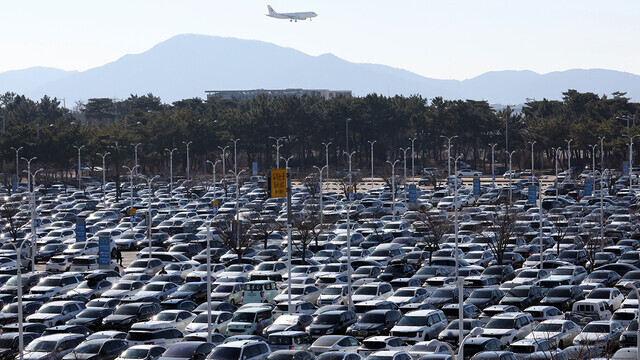
Vehicles fill the long-term parking lot at Terminal 1 of Incheon International Airport in January. (Photo = Yonhap News Agency) |
[Alpha Biz= Kim Jisun] Incheon International Airport Corporation has come under scrutiny after an audit revealed that it issued parking permits equivalent to approximately 85% of its total parking capacity primarily to employees and affiliated personnel.
The Ministry of Land, Infrastructure and Transport (MOLIT) announced on May 14 that its audit found the airport operator had been running parking facilities largely for staff convenience, granting widespread exemptions from parking fees.
According to the audit, the corporation issued a total of 31,265 long-term parking permits—both paid and free—covering 84.5% of the airport’s total 36,971 parking spaces. Free six-month renewable permits were provided to employees and staff of subsidiaries and tenant organizations, while monthly paid permits were issued to airlines and other tenants. Notably, there were no limits on the number of permits issued.
The audit also found that prime parking spaces preferred by passengers, including short-term parking lots within terminal buildings, were largely allocated to employees who were not permanently stationed at the airport. At Terminal 1, despite the existence of a designated employee parking lot located about 500 meters away, additional staff-only parking areas were created within the terminal building’s underground parking facility. As a result, less than half of the short-term parking spaces were available for general passengers.
MOLIT criticized the operator for failing to establish reasonable issuance limits or manage actual usage, stating that the indiscriminate distribution of parking permits has been a key factor contributing to chronic congestion at Incheon Airport parking facilities.
The audit further uncovered widespread misuse of parking permits by employees for personal purposes. In one case, an employee used a free parking permit for 22 days during a summer vacation abroad, avoiding parking fees amounting to KRW 552,000.
Authorities identified 1,220 cases over the past year where permits were improperly used for personal activities such as vacations or private outings, with total unpaid parking fees reaching approximately KRW 79 million.
Following the findings, MOLIT has instructed the corporation to strengthen issuance criteria and management controls, hold responsible officials accountable, discipline those involved in misuse, and recover unpaid parking fees.
Kim Yoon-duk emphasized that “airport parking facilities, as public assets, must be returned to the public,” and ordered the implementation of comprehensive corrective measures.
Alphabiz Reporter Kim Jisun(stockmk2020@alphabiz.co.kr)