

 |
Photo courtesy of Yonhap News |
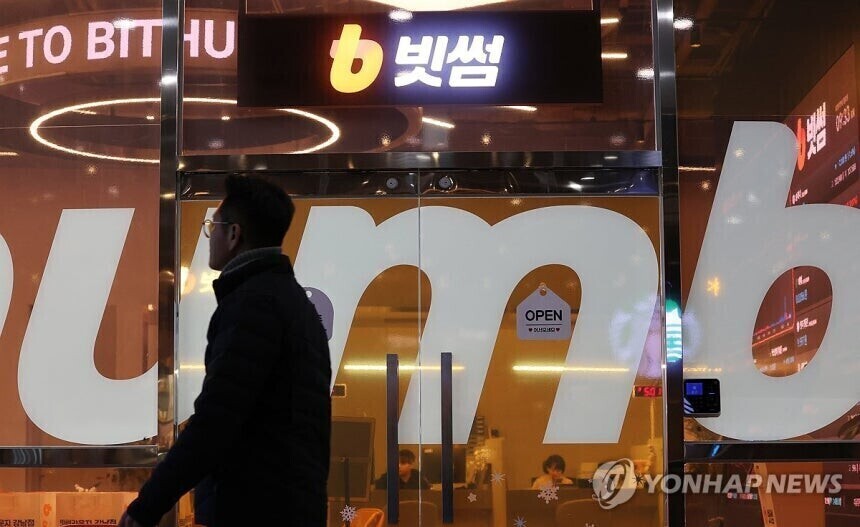
[Alpha Biz= Paul Lee] South Korea’s financial authorities said they are considering introducing a real-time verification system to continuously reconcile cryptocurrency exchanges’ actual holdings with their accounting records, following a 60 trillion won bitcoin overpayment incident at Bithumb.
According to written responses submitted on Wednesday by the Financial Services Commission (FSC) to the National Assembly’s Political Affairs Committee, the regulator said it will “review and pursue the introduction of a constant verification framework for on-hand assets and book balances” based on the results of its ongoing inspection.
The FSC was responding to a query from lawmaker Lee In-young regarding how asset–ledger reconciliation cycles and proof-of-reserves systems would be reflected in future licensing, registration and inspection standards.
The commission added that it plans to establish internal control standards for crypto exchanges comparable to those applied to financial institutions, and to mandate regular external audits of exchanges’ crypto asset holdings by third-party entities.
Earlier, Lee Chan-jin, governor of the Financial Supervisory Service (FSS), told a parliamentary hearing on March 11 that exchanges’ wallet balances and accounting systems should be linked in real time.
“Even a five-minute reconciliation cycle, as used by Upbit, is not short—it is actually very long,” Lee said, stressing that real-time synchronization is essential for system safety.
Regarding potential sanctions—including business suspension or license revocation—the FSC said the Financial Intelligence Unit (FIU) is currently conducting an on-site inspection of Bithumb to determine whether it violated the Act on Reporting and Using Specified Financial Transaction Information, including requirements related to suspicious transaction reporting systems. The FSC said strict measures would be taken if violations are confirmed.
Separately, the FSC noted that upcoming Phase Two cryptocurrency legislation is expected to include enhanced investor protection measures, such as safeguards against issuer bankruptcy risks.
Alphabiz Reporter Paul Lee(hoondork1977@alphabiz.co.kr)