

 |
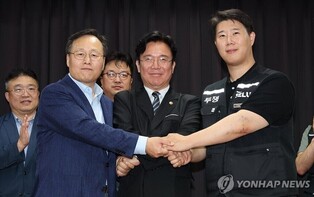
Yeo Myung-gu (left) and Choi Seung-ho sign a tentative wage agreement following labor negotiations at the Gyeonggi Regional Employment and Labor Office in Suwon on May 20, before joining Kim Young-hoon in a handshake. (Yonhap News) |
[Alpha Biz= Kim Jisun] SEOUL, May 31, 2026 — Calls by labor unions in South Korea to link employee bonuses directly to a fixed percentage of corporate profits are spreading across major industries, raising concerns among business groups over potential impacts on corporate governance and long-term competitiveness.
The Korea Enterprises Federation warned on May 31 that recent demands by unions at large corporations to formalize profit-sharing schemes—such as allocating a set portion of operating profit to employees—represent a fundamental shift from conventional performance-based compensation systems.
According to the federation, such proposals go beyond incentive-based rewards and instead amount to direct distribution of corporate earnings. “Corporate profits are strategic resources that should be allocated toward investment, hiring, research and development, and financial stability to ensure sustainable growth and future competitiveness,” it said.
The debate has intensified following recent labor negotiations at Samsung Electronics, where management and labor agreed to a 6.2% wage increase, the introduction of a special performance bonus system for the semiconductor division, and improvements to employee welfare programs.
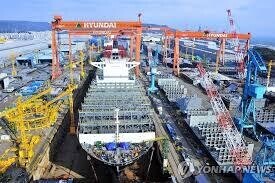
Similar demands have emerged across other major firms. The labor union at Hyundai Motor previously called for bonuses equivalent to 30% of net profit, while unions at HD Hyundai Heavy Industries and LG Uplus have requested 30% of operating profit. More recently, the union at Samsung Electro-Mechanics has demanded 12% of operating profit.
At Kakao, where the union is seeking bonuses amounting to 13–15% of operating profit, tensions have escalated further. The company could face its first-ever strike after mediation efforts by the regional labor commission were suspended, paving the way for a union vote on industrial action.
The federation emphasized that it is rare among global companies to pre-commit to distributing a fixed portion of profits to employees. While companies may choose to allocate part of their earnings to workers, such decisions should be made at management’s discretion rather than through collective bargaining, it said.
It also underscored the need to clearly distinguish profit-sharing payments from wages, noting that financial rewards tied to corporate performance should not be classified as regular salary under existing legal frameworks.
“Companies are under no legal obligation to accept union demands for profit-sharing,” the federation stated, adding that strikes primarily aimed at securing such distributions could be deemed unlawful under current labor laws.
The group concluded that performance-based compensation should be structured in a way that does not undermine long-term investment capacity or financial stability. It recommended shifting toward long-term incentive mechanisms—such as conditional equity-based compensation—aligned with both corporate performance and employee interests, rather than short-term cash payouts.
Alphabiz Reporter Kim Jisun(stockmk2020@alphabiz.co.kr)