

 |
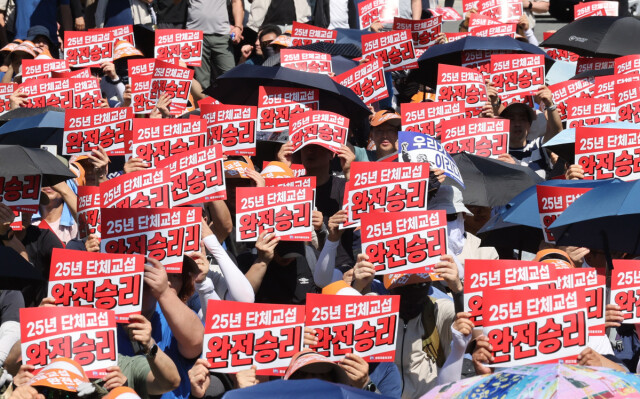
Union members chant slogans during a rally calling for a general strike held in front of the main building of Hyundai Motor’s Ulsan plant in Buk-gu, Ulsan, in September last year. (Yonhap) |
[Alpha Biz= Kim Jisun] Labor unions at Hyundai Motor Co. and Kia Corp. have agreed to launch a joint labor campaign for the first time in more than a decade, aiming to extend the statutory retirement age and introduce a 4.5-day workweek, Seoul Economic Daily has learned.
According to industry sources on January 20, Lee Jong-cheol, head of the Hyundai Motor branch of the Korean Metal Workers’ Union (KMWU), recently met with Kang Sung-ho, head of the Kia branch, during a leadership inauguration ceremony. The two union leaders agreed that coordinated action would be necessary to achieve socially driven agendas, including raising the legal retirement age to 65 and implementing a 4.5-day workweek. They also decided to begin working-level discussions to prepare a joint proposal.
It is highly unusual for the Hyundai Motor and Kia unions, which have traditionally negotiated separately, to engage in collective action. The move reflects the unions’ assessment that issues such as retirement age extension and reduced working hours are structural matters that cannot be resolved at the individual company level. The upcoming enforcement of the so-called “Yellow Envelope Act” in March — amendments to Articles 2 and 3 of the Trade Union and Labor Relations Adjustment Act — is also seen as a key factor, as it is expected to expand the scope of lawful strikes and reduce legal risks related to damage claims.
Management circles have voiced concern over the unions’ demands, warning that extending the retirement age and shortening the workweek could undermine labor productivity and limit youth employment. South Korea’s hourly labor productivity stood at USD 44.4 in 2023, significantly below the OECD average of USD 56.5. Industry analysts note that reducing working hours under such conditions would inevitably increase labor costs to maintain output levels.
Concerns are further compounded by the potential impact of a higher statutory retirement age, which could constrain companies’ ability to hire younger workers. Amid growing external pressures such as U.S. trade policies and the need for large-scale investments in next-generation businesses including robotics, labor demands could add to the management burden at Hyundai Motor Group, analysts say.
Labor pressure is also intensifying across the broader manufacturing sector ahead of the Yellow Envelope Act’s implementation. The KMWU recently issued a directive encouraging affiliated subcontractor unions to demand direct collective bargaining with principal contractors. Industry observers expect a sharp rise in such demands, as the directive was issued at the federation level.
In fact, the labor union at Motras, a Hyundai Mobis subsidiary producing modules and parts, has recently requested direct negotiations with Hyundai Mobis for the first time. Similar moves have been confirmed at subcontractor unions affiliated with Hanwha Ocean and Hyundai Steel, which are seeking direct talks over performance-based compensation standards and alleged illegal dispatch issues.
As union pressure mounts, business leaders are increasingly concerned that this year’s spring labor offensive could escalate to an unprecedented scale. Under the revised law, the definition of employers would be broadened and the scope of labor disputes expanded to include management decisions affecting working conditions, potentially bringing previously unlawful strike demands — such as reduced working hours and retirement age extension — into the realm of legal industrial action.
Alphabiz Reporter Kim Jisun(stockmk2020@alphabiz.co.kr)















![[화보] 최립우·강우진, 듀오 데뷔 앞두고 화보 공개](/news/data/20260406/p1065604128065496_761_h2.jpg)